The Evidence Is the Voice: A New Model for Academic and Professional Recognition
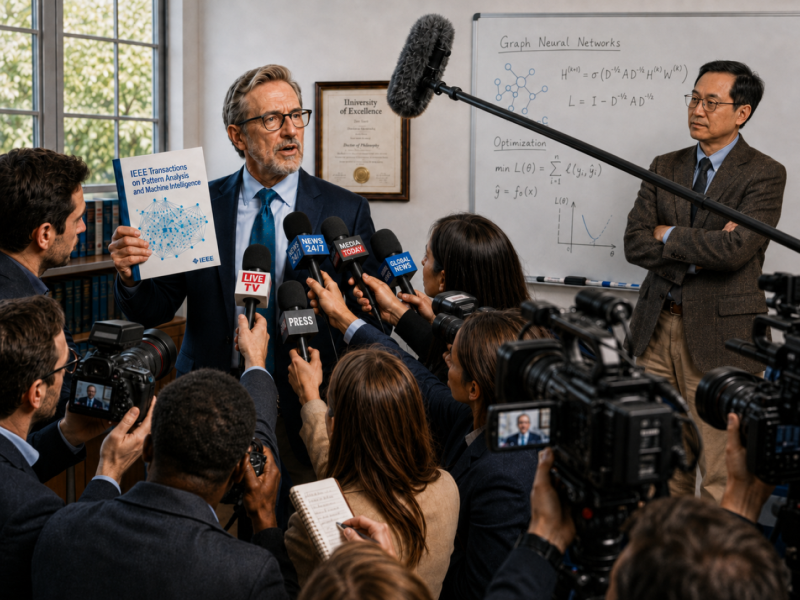
Recognition in the academic and professional worlds is too often determined by who has the loudest voice, not who has the strongest evidence. Evidence points to a growing demand for a better way to discover and recognize expertise.
Introduction
Academic knowledge is built on evidence. Research visibility, in this context, is the process of making both research outputs and the researcher’s underlying expertise discoverable and recognized—not just making publications easier to find. Recognition, however, is contradictory.
Researchers and academics can spend years developing expertise, producing rigorous work, and contributing knowledge to their fields. Their publications may contain substantial evidence of what they know. Yet in a crowded field, the researchers receiving the most attention are not necessarily those with the strongest evidence behind their expertise. Visibility can favor those who publish frequently, promote themselves effectively, have large networks, or simply make more noise.
There is another problem: research is increasingly collaborative. Papers are frequently written by multiple contributors, sometimes across institutions and disciplines. The publication establishes a shared record of the work, but it does not necessarily make each individual's contribution or area of expertise apparent. An academic can make a significant contribution to a paper without receiving recognition for the specific knowledge they brought to it.
Artificial intelligence is changing how people navigate this environment. AI can read across thousands of documents, identify subjects and themes, connect related research, and identify researchers associated with particular areas of knowledge. What it does not inherently provide is a persistent, person-centered evidence graph showing why a particular researcher should be recognized for the expertise represented across those sources and in their continuing activity.
That distinction matters because traditional publication counts and visibility signals often fail to show who actually has the strongest, best-supported expertise. For researchers trying to build credible recognition in their field, the issue is not just discoverability, but whether reputation reflects evidence rather than noise or self-promotion.
A researcher may have demonstrated expertise across dozens of publications and other sources, with each individual document providing only part of the picture. In a multi-author paper, the evidence of an individual's contribution can be even less apparent. Real-time professional activity can provide additional evidence of knowledge that never appears in a publication. Taken together, these signals can reveal a depth and breadth of expertise that is difficult to see by examining any single article or publication record or even multiple documents.
The problem: Evidence is often scattered while attention is concentrated.
In a noisy field of experts, visibility can favor the person who is most active, most connected, or most effective at attracting attention. The loudest voice can become the most recognizable voice, even when another researcher has a deeper or better-supported body of expertise.
Academic credibility, however, is supposed to work differently.
Academics prioritize facts, evidence, and demonstrated knowledge. Recognition should follow the evidence rather than the volume of the voice presenting it.
The challenge is therefore not simply how to get research noticed. It is how to make the evidence of expertise visible at the individual level, so that the researcher can be recognized for the knowledge they have actually demonstrated and the contributions they have actually made.
This article examines that gap between research visibility and researcher visibility, including the limits of collaborative authorship, the role of evidence in academic credibility, the place of academic personal branding, and how AI is changing the way expertise is discovered.
That distinction becomes increasingly important as AI makes knowledge easier to find
The next question is whether the person behind that knowledge can become just as discoverable—and whether the evidence can establish that person as a source of expertise rather than leaving the recognition attached primarily to the publications themselves.
Research Visibility Is About More Than Being Published
For many academics, research visibility begins with publication. A paper is published, indexed, cited, and made available to other researchers. That creates an important record of the work, but publication alone does not guarantee that the individual researchers who contributed to it will become visible for their expertise.
A publication is primarily a record of the research. It is not necessarily a complete representation of the people who produced it.
This becomes particularly important when research involves multiple contributors. A paper may include researchers with very different areas of expertise, levels of experience, and responsibilities. One researcher may have contributed a specialized methodology, another may have provided domain expertise, and another may have developed an important technical component. Once the paper is published, however, those distinctions can be difficult to see without examining the underlying work in detail.
The result is that recognition can accumulate around the publication while the expertise of the individual contributors remains less visible.
The same problem exists across a researcher's body of work. A researcher may have contributed to numerous papers, worked across related domains, developed specialized knowledge, and continued applying that knowledge in professional or technical settings. Each individual source provides evidence, but no single publication necessarily shows the complete picture.
This is where research visibility becomes different from simply having research available.
Research visibility is not only about whether a paper can be found. It is also about whether the researcher can be found for the expertise demonstrated through that paper and the broader body of evidence surrounding it.
Building a Stronger Academic Presence
That distinction changes the question from: "How can more people find my research?" to: "How can more people recognize that I am a source of expertise in this field?". For academics, that is an important difference. The objective is not to compete with the research itself for attention. It is to ensure that the researcher does not disappear behind it.
For academics, that is an important difference. The objective is not to compete with the research itself for attention. It is to ensure that the researcher does not disappear behind it.
A strong research record should provide evidence of expertise. The challenge is making that evidence visible as evidence of the individual, particularly when it is distributed across many publications, shared among multiple contributors, and accumulated over years of work.
Research visibility, therefore, is ultimately about more than getting published. It is about being discoverable for what the research demonstrates that a researcher knows. It is about being discoverable for what the research demonstrates that a researcher knows.
An academic online presence is increasingly composed of many different pieces. Researchers may have institutional profiles, journal publications, conference contributions, patents, technical work, professional profiles, and other publicly available evidence of their expertise. Each provides useful information. Together, however, they can still leave an incomplete picture of the researcher.
A strong researcher profile should help answer three basic questions: Who is the researcher? What do they know? What evidence demonstrates that knowledge?
Academic Credibility Comes From Evidence
Academic credibility is built through demonstrated knowledge. A researcher's credibility does not come simply from having a title, publishing a paper, or being associated with a respected institution. Those things can provide context, but they do not by themselves demonstrate the depth of knowledge an individual possesses.
Evidence accumulates over time.
A publication can demonstrate knowledge of a particular subject. A series of publications can reveal sustained expertise. Work across related subjects can demonstrate breadth. A patent or technical contribution can provide evidence of applied knowledge. Continued activity within a field can provide additional evidence that expertise is not limited to a single contribution or moment in time.
The challenge is that this evidence is rarely presented as a complete picture of the individual.
Instead, it is distributed across publications, projects, patents, technical contributions, and other records. In collaborative research, an individual's contribution may be further obscured by the number of authors involved. Someone examining a single paper may see the research and the list of contributors without understanding the full extent of the expertise demonstrated by any one person.
This matters because credibility is stronger when it can be demonstrated rather than simply asserted.
An academic should not have to be the loudest person in the field to establish authority. They should not have to rely on personal promotion to convince others that they possess expertise. The evidence of their work should be capable of establishing that credibility on its own.
This is particularly important in an environment where information is increasingly abundant and attention is increasingly competitive. When many people can be associated with the same subject, the meaningful distinction is not necessarily who is most visible. It is who can demonstrate the strongest evidence of knowledge.
Academic credibility, at its foundation, is therefore a question of evidence: What has this researcher demonstrated that they know, how consistently have they demonstrated it, and what does the accumulated body of evidence reveal about their expertise?
Making that evidence visible is what allows credibility to become discoverable.
From Research Visibility to Researcher Visibility
Research visibility and researcher visibility are not the same thing.
Research visibility asks whether a paper, study, or body of research can be found. Search engine optimization helps articles surface during database queries. Keywords also matter because academic databases index content based on keywords. Researcher visibility asks whether the person responsible for the expertise demonstrated in that work can be found and recognized for it.
That distinction becomes especially important when a researcher has contributed to a large body of work. A publication may be highly visible while the specific expertise of an individual contributor remains difficult to identify. Someone searching for a subject may find the paper, read the findings, and even recognize that the research is valuable without ever developing a clear understanding of which researcher has the relevant depth of knowledge.
The same problem can occur across an entire career. A researcher may have demonstrated expertise repeatedly across dozens of publications, related fields, technical contributions, and other professional activity. Each piece of evidence may be discoverable, but the accumulated expertise of the individual is much harder to see.
Researcher visibility changes the question.
Instead of asking only, "Can this research be found?", the question becomes: "Can the person who has demonstrated this expertise be found because of it?"
That creates a fundamentally different form of discoverability. Someone does not have to begin with the researcher's name, institution, or existing reputation. They can begin with a problem, subject, or area of expertise and discover the researcher through the evidence associated with that knowledge, with strong, precise terms improving discoverability in Search Results and increasing citation likelihood. Choose specific phrases that relate directly to the work. Including synonyms can broaden the range of searches in which the work appears.
For academics, this distinction matters because recognition should not depend entirely on already being known. A researcher should be able to become visible because the evidence demonstrates that they belong in the conversation.
In a crowded field, that can be especially important. Many researchers may legitimately work in the same broad area, but their depth, breadth, and specific contributions can be very different.
Research visibility makes the work discoverable.
Academic Reputation and Research Recognition
Academic reputation is built over time. It develops through the accumulation of research, contributions, expertise, and recognition from others within a field. But the existence of a strong body of work does not automatically mean that the researcher will receive recognition proportional to that work.
Recognition depends, in part, on visibility. Institutional communications can also help promote research findings to a wider audience.
A researcher can contribute important knowledge to a field while remaining relatively unknown outside a limited academic network. Another researcher working in the same field may receive considerably more attention because their work is more visible, their network is larger, or they are more effective at promoting themselves. Neither visibility nor recognition necessarily reflects the difference in the underlying evidence.
That creates a problem for academic reputation.
If recognition is driven primarily by attention, then the researcher who communicates the most effectively can become more recognizable than the researcher whose body of work provides stronger evidence of expertise. In an increasingly crowded information environment, this gap can become even more pronounced.
Research recognition should have another foundation.
The evidence accumulated through a researcher's work can provide a much more meaningful basis for understanding their expertise. Multiple publications can demonstrate sustained knowledge. Contributions across related subjects can reveal breadth. Technical work can demonstrate application. Continued activity can provide evidence that expertise remains active rather than being tied to a single publication.
When that evidence can be seen together, it becomes easier to distinguish a researcher who has genuinely developed expertise from someone who is simply highly visible within the same field.
This does not mean that visibility is unimportant. Visibility is what allows evidence to be encountered in the first place. Engaging with media can broaden the audience for that work. Higher visibility can also help research inform public policy and industry practices, with references in policy documents serving as one sign that the work is being used. But visibility should lead people to the evidence, rather than becoming a substitute for it.
For academics, that distinction matters. Recognition should not depend on being the loudest researcher in the room. It should be possible for a researcher to become recognized because the accumulated evidence demonstrates that they have something important to contribute.
Evidence creates credibility. Visibility makes the evidence discoverable. Recognition follows when others can see it.
That is the foundation on which a stronger academic reputation can be built.
Academic Personal Brand Without the Hype
Academic personal branding can sound out of place in a field built around evidence. Researchers are trained to build credibility through the quality of their work, not through how effectively they market themselves.
But personal branding, at its most useful, does not have to mean self-promotion. It can simply mean making an individual's expertise, contributions, and professional identity easier for others to understand by helping them define and communicate a personal brand grounded in evidence.
That distinction matters because academics already have a substantial body of material from which their professional identity can be understood. Their publications, research contributions, technical work, patents, collaborations, and continuing activity all provide evidence of what they know and where they have developed expertise.
The challenge is that this evidence is often scattered.
A researcher may have a strong online profile, but that profile is only one part of a broader professional brand and does not necessarily communicate the full scope of their expertise. A list of publications shows what someone has contributed to, but it may not reveal the patterns across that work. A biography can describe an area of specialization, but it is still a description. A personal website can present accomplishments, and the same is true of LinkedIn or even a professional head shot, but it depends on how effectively the researcher chooses to present them. The strongest presentation should reflect actual expertise and value. A personal brand should be authentic and consistent across platforms. In practice, that means choosing to define a clear professional narrative and keeping the focus on demonstrated expertise rather than image.
The strongest professional identity is therefore not necessarily the one that is promoted the most. It is the one that is supported by the most visible evidence.
For academics, this creates an opportunity to think about personal branding differently. The objective is not to become louder than other researchers. It is to make the existing evidence of expertise easier to see, understand, and associate with the person who produced it.
That is particularly valuable in a crowded academic environment. When researchers are competing for attention, a professional identity grounded in evidence provides something that promotion alone cannot: a reason for recognition that does not depend on who speaks the loudest.
Academic personal branding, in this sense, is not about creating an image of expertise.
It is about making the evidence of expertise visible enough that the researcher becomes recognized for what they actually know. A clear brand can also support career opportunities, including a future job, by helping others understand the expertise or services a researcher can offer.
What the Early Public Profiles Are Showing
The number of public profiles is still nascent. There are currently only a small number of professionals with public profiles, so there is not yet enough data to make broad claims about how this model will perform across the professional or academic community. The sample is small, and some of the metrics are still being understood.
What is already difficult to ignore, however, is the strength of the evidence coming from the profiles that do exist. Where these pages compete with thousands of pages. Yet with only a small number of public profiles, experts are the 5th highest category.
The public profiles are receiving a surprising amount of traffic relative to their very small number. That traffic does not, by itself, tell the entire story. More data is needed to understand exactly what the individual metrics mean, where the interest originates, and how that behavior will develop as more professionals participate. But one thing is already clear: there is significant interest in discovering evidence backed expertise.
There is also an important distinction in what constitutes expertise. The creation of knowledge is only one part of it. For academics, writing and publishing are among the most visible forms of expertise because they leave a public record. But expertise is also developed and demonstrated through practice, discussion, study, and continued interaction with a field of knowledge.
Those activities are generally invisible to the outside and, in many cases, not visible on the open internet, yet they are highly important to credibility.
A researcher can spend hundreds of hours studying a subject, discussing complex problems with other experts, applying knowledge in practice, or working through difficult problems without producing a publication that records those activities. Those experiences contribute to the depth of the individual's expertise, but they are not normally visible in academic search systems, publication databases, or the open web.
Consequently, they are not necessarily available for an AI system to discover and associate with the individual.
This creates a significant difference between what can be found about an expert and what actually constitutes their expertise.
When these different forms of activity can be distinguished and represented as evidence, a much richer picture emerges. Knowledge creation, practice, discussion, and study can contribute different signals to the overall representation of expertise rather than being treated as though all knowledge comes from publications.
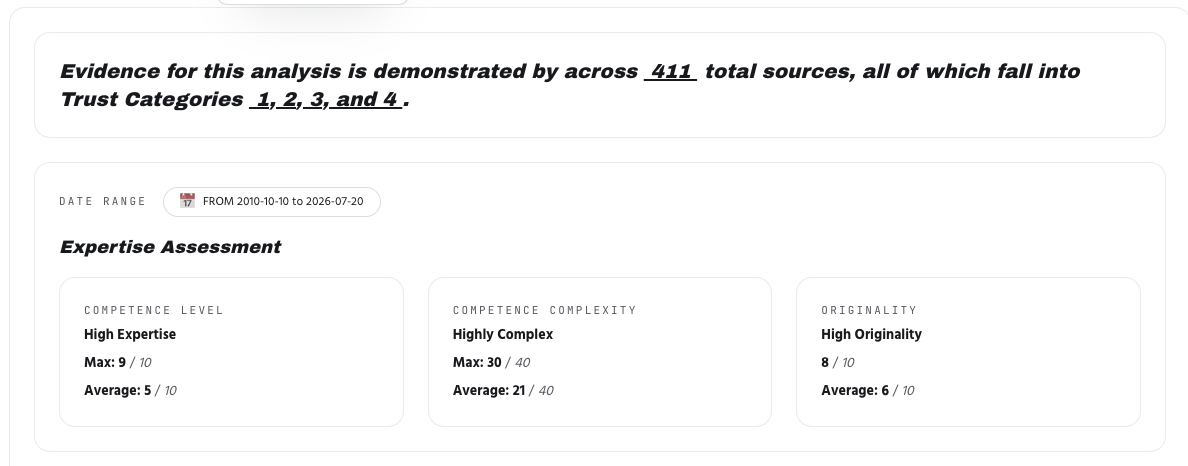
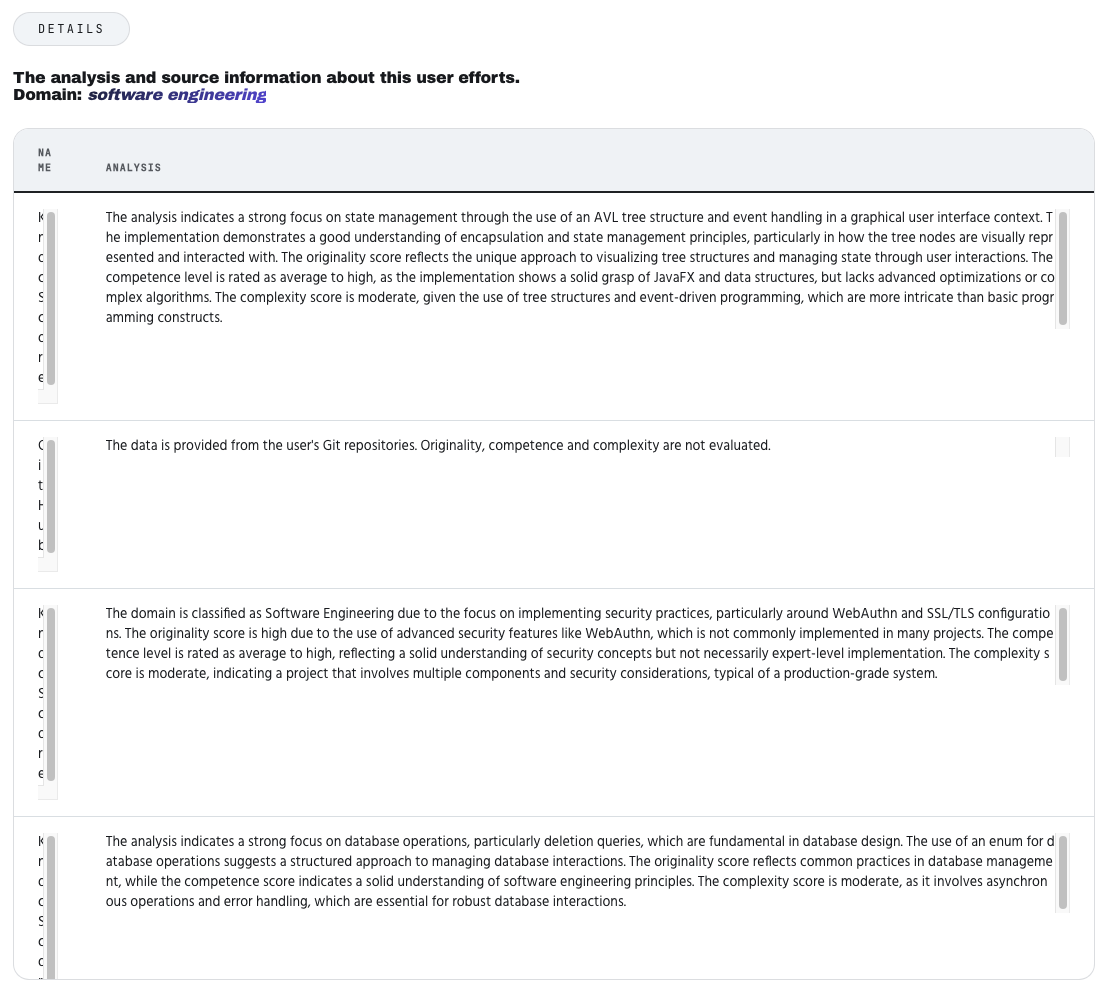
That evidence can then be brought together from multiple sources and ongoing activity to create something closer to an evidence-based directory of expertise: not simply a list of professionals who claim knowledge in a particular area, but a way to identify who has demonstrated knowledge and where that expertise exists.
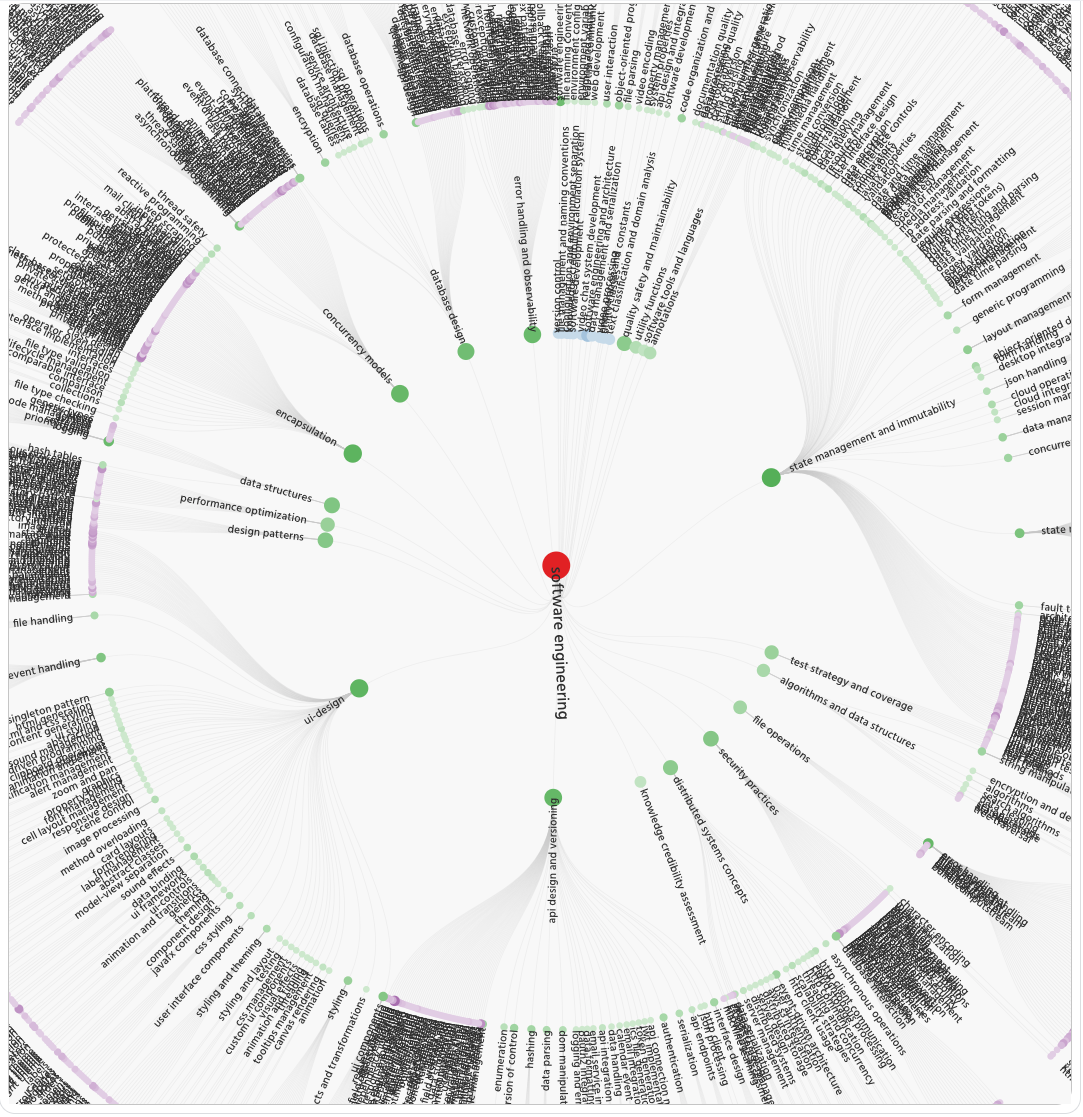
The visual representation makes this particularly apparent. A professional's expertise can be represented as a radial tree containing thousands of evidence nodes. The structure can show the relationships among areas of knowledge while revealing differences in depth, breadth, and density at the sub-node level. This complements expertise ratings, while hours spent within a domain of knowledge is represented from discussions, creation of documents, studying, and practicing within a particular domain. Value may also be represented when present.
That changes the nature of a professional profile.
Instead of a short description saying that someone is an expert in a particular field, the evidence can be examined as a connected structure. The professional becomes visible through the accumulation of evidence rather than through the strength of personal promotion.
This also introduces a much larger possibility: a fundamental trust layer for expertise.
Organizations, researchers, journalists, businesses, peers, and others frequently need to answer a simple question: Who can actually provide expertise on this subject—for example, "urban flood risk"? Today, that answer can depend heavily on reputation, referrals, search rankings, institutional affiliation, or whoever happens to be most visible.
An evidence-based representation changes that equation.
The question becomes less about who claims to be an expert and more about who has demonstrated the knowledge.
The early public profiles do not yet provide enough data to establish exactly how large this opportunity is. They do provide something important: an early and unexpectedly strong indication that people are interested in finding expertise, and that an evidence-based representation of that expertise can attract attention.
For academics, that creates an important possibility. Researcher visibility does not have to depend solely on the visibility of individual publications or the volume of attention surrounding a researcher. Expertise itself can become something that is discoverable and evaluated through evidence—including forms of expertise that would otherwise remain invisible online.
The significance may ultimately extend beyond research visibility. It may provide a foundation for making expertise itself more findable, understandable, and trustworthy.
Why This Matters for Academics
For academics, the implications extend well beyond making published research easier to find. One of the benefits is reaching a broader audience beyond publication-based measures.
A significant amount of academic expertise exists outside publications. Professors may spend years teaching, studying, advising, practicing within their discipline, discussing complex problems with colleagues and students, developing curriculum, or applying specialized knowledge without producing a large body of published research. That does not make their expertise less real. It simply means that much of the evidence of that expertise is not captured by publication-based measures of academic visibility.
This creates an important gap in how academic expertise is recognized.
A professor who has spent twenty years developing deep knowledge in a specialized field may have considerably more expertise than their publication record suggests. Another academic may be highly accomplished as a teacher, practitioner, or advisor while receiving little recognition outside the institution where that expertise is already known.
For these academics, traditional measures of research visibility can provide an incomplete picture.
An evidence-based representation of expertise creates another possibility. Instead of limiting recognition to what has been published, it can recognize the broader accumulation of knowledge demonstrated through study, practice, discussion, and creation.
That distinction could be particularly meaningful for professors who do not publish extensively. Their lack of publications should not automatically make them invisible when they have spent years developing expertise in their field.
This also changes how academic reputation can develop.
A professor should not have to become a prolific publisher, build a large social following, or compete for attention to establish that they possess valuable knowledge. Offline, recognition often depends on reputation within an institution unless that expertise is made visible online. Their expertise can be represented through the evidence of how they have engaged with their field, though doing so also brings practical challenges for academics who are not focused on self-promotion.
This creates an opportunity for a much broader definition of academic recognition—one that recognizes not only what academics have published, but what they actually know and have demonstrated through their work.
For academics, that may be one of the most important consequences of making expertise visible: recognition no longer has to stop at the publication.
The Loudest Voice Is No Longer the Evidence
For a long time, recognition has followed visibility. The people who were best connected, most established, most frequently published, most promoted, or simply the loudest often became the people recognized as experts. Visibility, reputation, and access to networks could become proxies for expertise, while equally capable people remained overlooked.
That does not have to remain the standard. Evidence creates another path to recognition. Knowledge can be demonstrated through the work a person creates, the problems they solve, the subjects they study, the conversations they engage in, the practice they perform, and their sustained interaction with a field. Individually, these interactions may reveal little. Accumulated over time, they can reveal a great deal.
For academics, that accumulation can extend beyond publications. It can provide recognition for knowledge previously visible only to colleagues, students, collaborators, or those who happened to encounter it directly. A professor who publishes little can still have decades of deep expertise. A researcher can make an important contribution to a collaborative paper without that contribution being obvious from the publication. The evidence of their knowledge can exist beyond what gets written.
The same principle extends into the professional world. Business professionals can be overlooked because recognition is influenced by networks, credentials, institutional affiliation, reputation, or other forms of bias. Important skills and hard work can remain hidden when recognition follows noise rather than evidence. An evidence-based representation of expertise creates another way to recognize knowledge and talent: through what a person has actually done and how they have engaged with what they know.
That creates a fundamental shift in how expertise can be discovered and recognized. The question is no longer simply who is most visible, who has the largest network, or who speaks with the greatest authority. It becomes: What does the evidence show?
That is the foundation of KnocScore. By accumulating evidence of knowledge and making it visible, KnocScore gives the individual something that has rarely existed before: a persistent trail through which expertise can speak for itself. A researcher, professor, engineer, physician, business professional, or specialist does not have to be the loudest person in the field to be recognized. The evidence can establish the depth, breadth, and substance of what they know.
The result is a different model of professional recognition—one in which visibility does not have to determine whose expertise matters, and knowledge and talent can become discoverable because the evidence supports them.
That raises a much larger question.
If expertise can become independently visible through evidence, how does that change academia? How does it change the professional world?
The loudest voice is no longer the evidence.
The evidence is now the voice.
Publish in the KnocScore Journal.
Long-form writing in your domain contributes to your KnocScore and gives your work a home readers can trust.