Evidence, not claims.
Professional trust today rests on résumés, self-written profiles, and hard-to-verify references. KnocScore takes a different approach — building a credibility profile from observable evidence across trusted sources.
01 · The problem
Every professional already knows this.
Résumés are self-reported.
Anyone can write anything. There is no verification layer.
Profiles contain unlimited claims.
LinkedIn and similar platforms accept any assertion at face value.
References are hard to verify.
They take time, favor insiders, and rarely reveal what someone actually knows.
Credentials show education — not knowledge.
A degree from a decade ago says little about current, demonstrated ability.
The result: trust takes weeks to establish, hiring risk stays high, and real expertise gets buried under polished claims.
02 · A different approach
Credibility built from what you have actually done.
KnocScore introduces a different approach to professional credibility. Instead of relying primarily on credentials or self-reported claims, KnocScore builds a knowledge credibility profile from observable evidence gathered across trusted sources — organized into the domains of knowledge where you actually work.
03 · The process
Three steps from evidence to profile.
Step 1
Connect trusted sources
Professional activity is gathered from trusted sources you approve and organized into domains of knowledge.
Step 2
Analyze demonstrated knowledge
KnocScore evaluates observable evidence — experience, work, technical contributions, research, discussion, patents, publications, and other verified activity.
Step 3
Display a Knowledge Credibility Graph
The result is a visual profile showing depth, breadth, trust, experience, and interaction history — not a single opaque score.
A quick preview
What a Knowledge Credibility Graph looks like.
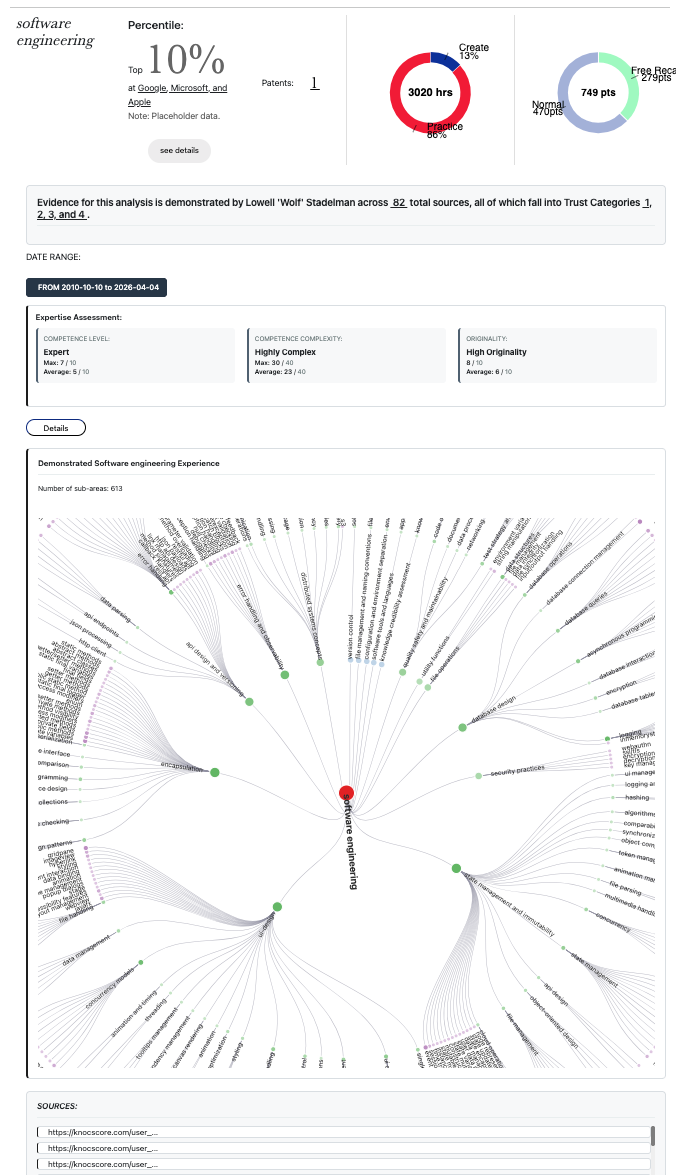
Real graph representation
Radial Tree — Graph Representation
Radial tree
Each node represents density. Lighter, smaller nodes have fewer interactions. A dense tree represents high expertise.
Top-level field
Shows breadth and depth, with a start and end date of engagement used for relevance.
Gauges
Hours of effort and the type of interaction: discussion, creation, practice, or study — and for study, the types of memory engaged.
Expertise assessment
Level of expertise, complexity, and originality, each rated between average and highest engagement.
Trust categories
Sources are selectable by probability of correctness, from Cat I (highest trust) to Cat V (lowest).
Inspectable sources
Links to sources and analysis are provided. When sources are publicly available, the observer can check them.
More can be learned in the wiki under “Understanding the metrics.”
Peer comparison
Apples-to-apples comparison.
Employers and observers can see how well a user's knowledge compares with others in the industry — where they sit against the field average, and how deep their demonstrated evidence runs.
That is what turns a profile into a hiring signal. Instead of weighing polished claims, an observer reads a comparison built from the same evidence rules for everyone — so individuals can hire with greater confidence.
-
Measured against a peer group
A profile is placed against professionals working in the same industry and the same domains of knowledge — not against everyone.
-
Same measurement every time
Evidence is gathered and scored the same way for each profile, so the comparison is like for like.
-
Open to inspection
The comparison rests on sources and analysis an observer can check, so the position shown can be verified.
Illustrative example
software engineering
Percentile in peer group
Top 10%
Competence level
Expert
Competence complexity
Highly complex
Originality
High originality
04 · What makes it different
Traditional profiles vs. KnocScore.
Internet safety
A thin profile contradicts the claim.
Online, anyone can claim experience they do not have — even under their real name. A thin profile makes that contradiction visible: the work a person claims to have done, and the knowledge activity their profile actually shows, do not line up.
-
A real name is not evidence.
A profile can carry a person's legal name and still be empty. The name tells you who is speaking — not whether they did the work they claim.
-
The graph shows the difference.
Someone with years of claimed experience presents a dense graph: large nodes, sustained interactions, engagement dates across the field. A thin profile shows the opposite.
-
Safer decisions online.
Observers can weigh an application against the evidence it presents before extending trust — in hiring, in collaboration, and anywhere credibility matters.
05 · What each audience gets
Built for the people who need trust most.
Business Professionals
" I need to establish credibility quickly. "
- Demonstrate expertise
- Build trust before meetings
- Differentiate beyond a résumé
- Share verified knowledge
Recruiters
" I need confidence before interviews. "
- Evaluate beyond résumés
- Reduce false claims
- Compare candidates more objectively
- Find demonstrated expertise
Business Owners
" I need to know who I can trust. "
- Evaluate expertise
- Reduce hiring risk
- Validate consultants
- Build stronger teams
06 · Why KnocScore Matters
A trust model built to be examined.
Trust Has Never Been More Important
AI has fundamentally changed the economics of deception. Nearly 50% of newly published online articles are primarily AI-generated. Gartner reports that 39% of job candidates surveyed used AI during the application process, including to create résumés, cover letters, and assessment answers. Distinguishing genuine expertise from manufactured credibility is becoming increasingly difficult, costly, and time-consuming.
KnocScore Reverses How Trust Is Established
Instead spending weeks or months establishing credibility, KnocScore acts as an unbiased historian validating credibility with evidence. Its hierarchy of trust evaluates the probability that information is accurate, including whether the identified individual was actually observed interacting with knowledge.
Evidence is categorized by its source, transparency, independent verification, and consequences for misrepresentation. Users can quickly establish if the observed user has trustable evidence in the areas that matter most.
-
Category I — Directly Observed: Identifiable individuals actively interacting with knowledge through observable activities, including video conversations, software, connected applications, and hardware.
-
Category II — Independently Accountable: Records backed by independent oversight and meaningful reputational or economic consequences for errors or misrepresentation.
-
Category III — Reputation-Based: Evidence supported by reputational consequences, but with limited transparency or independent oversight.
-
Category IV — Third-Party Reports: Claims supported by others, but with limited verification and relatively little accountability.
-
Category V — Self-Reported: Résumés, social profiles, and other claims with little independent verification or consequence for fabrication.
Further details about the categories of trust are found in the wiki understanding knocscore metrics.
Doors Open Faster When Your Expertise is Established
By prioritizing observable, attributable interactions over opinions and self-reported claims, KnocScore substantially reduces the opportunity for fabricated evidence to influence assessments. Every interaction contributes to an auditable record of knowledge and capability, weighted by the reliability of its source.
What once required weeks, months, or years to establish can begin within minutes.
Relations no longer begin with skepticism and meetings begin with trust.
Patent pending
The KnocScore method is patent pending — protecting a novel approach to knowledge credibility.
Trusted sources only
Evidence is drawn from sources with a verifiable link to real professional activity.
Transparent categories
Trust categories are defined, documented, and consistent across every profile.
Inspectable evidence
Every credibility signal can be traced back to the underlying evidence item.
07 · Privacy
Your evidence. Your controls.
You control visibility
Choose what appears on your public profile and what stays private.
Trusted sources only
Only approved sources contribute evidence to your profile.
Permission-based
Nothing is connected without your explicit approval.
Granular privacy controls
Tune what different audiences see, at any time.
08 · The outcome
Introduce yourself with evidence.
Imagine introducing yourself at a conference, applying for a position, pitching a client, or joining a new team with a credibility profile that demonstrates your capabilities — not just what you say about yourself. No arguments, no turf wars, done.
Build a KnocScore profile.
Create your Knowledge Credibility Profile in four steps. No guesswork — here is exactly what happens after you sign up.
- 1Create account
- 2Connect trusted sources
- 3Review your profile
- 4Share your KnocScore