Is AI a threat to your job? (2026 Outlook and what to do now)

AI is both a threat and an opportunity for jobs. According to the World Economic Forum, AI was expected to...
I Is AI a threat to your job? This is a pressing question for many professionals today. If you are concerned about how artificial intelligence might impact your career—whether you are just starting out, mid-level, or a seasoned expert—this article is for you. We will cover which jobs are most at risk, how to assess your own exposure, and practical steps to future-proof your career in an AI-driven world. The timing is important. The resources are available—the question is whether you’ll invest the effort to use them.
This article is written for professionals across all industries who are concerned about AI's impact on their careers. Whether you are early in your career, mid-level, or a seasoned expert, AI will impact your career. The information here will help you understand your risk and how take action.
We cover:
- Which jobs are most at risk from AI automation
- How to assess your own exposure to AI-driven changes
- Practical steps to future-proof your career and remain competitive
In 2026, most professionals are working alongside AI rather than being fully replaced by it, but exposure is growing rapidly in data-heavy, rules-based roles.
Is AI Really a Threat to Your Job in 2026?
This is a nuanced question. Job disruption due to technology isn't new. We've been here before. The Industrial Revolution marked one of the first disruptions to jobs outside of war. It began in Great Britain about 1750-1760 but didn't have a great impact until later. In the USA its impact is marked at about 1876. Since then, technological change has frequently been a disruptor. Most of the time it is a minor disruption, but the Industrial Revolution was significant.
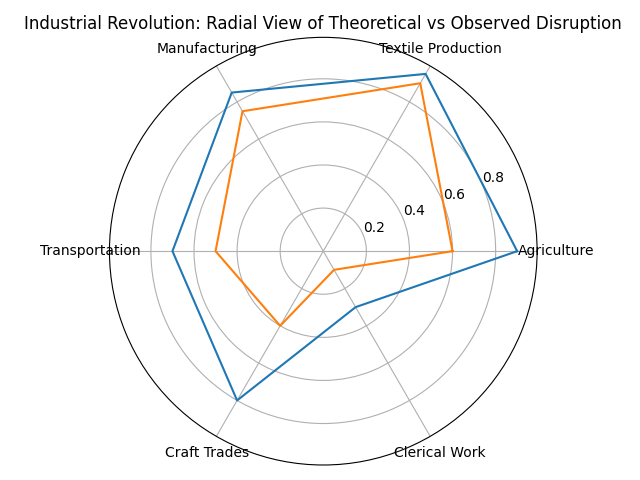
The largest impact was at the beginning of the 19th century. At the time, the vast majority of the workforce was engaged in agriculture, with 90% of jobs centered around manual labor. The Industrial Revolution marked a profound transformation, introducing mechanization and new manufacturing processes that dramatically reshaped the labor market.
As we see in the chart below from the Industrial Revolution, much of the labor market was impacted by the dramatic change. Yet, while many suffered widespread job loss, the revolution ultimately led to a more efficient society, creating new industries and opportunities for the future workforce. This shift brought significant improvements in productivity, and eventually leading to the high living standards we now enjoy. Although, not without significant growing pain.
More recently in the 1990's was the digital revolution. We saw the beginning of the industry that created the computers and mobile smart phones and the software that runs on them. This displaced jobs in area's that computing could easily change. The disruption was softened by the difficulty to develop hardware and software and the challenges with educating, learning, and gaining expertise to produce 'good enough' products. Below is the chart representing the careers that were disrupted.
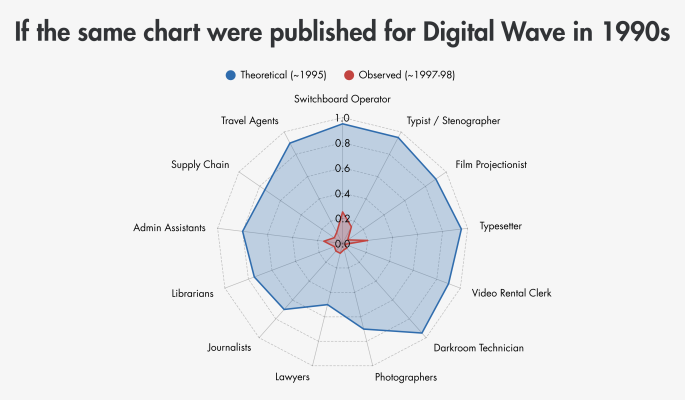
The disruption created far more jobs than it removed. However, the shift as seen in the U.S. was from a focus on services with higher demand for knowledge, and an export of labor and goods production. For every manufacturing job lost, there were 15.8 new jobs created (Rockefeller Institute of Government, 2019).
AI's Four Year Impact 2022-2024
The change driven by AI to date is shown in this chart below published by Agentic, the creator of Claude.AI. Note that this is an early snapshot. What is in red is where we are in early 2026 and what is in blue are the total theoretical risk of the exposed industries.
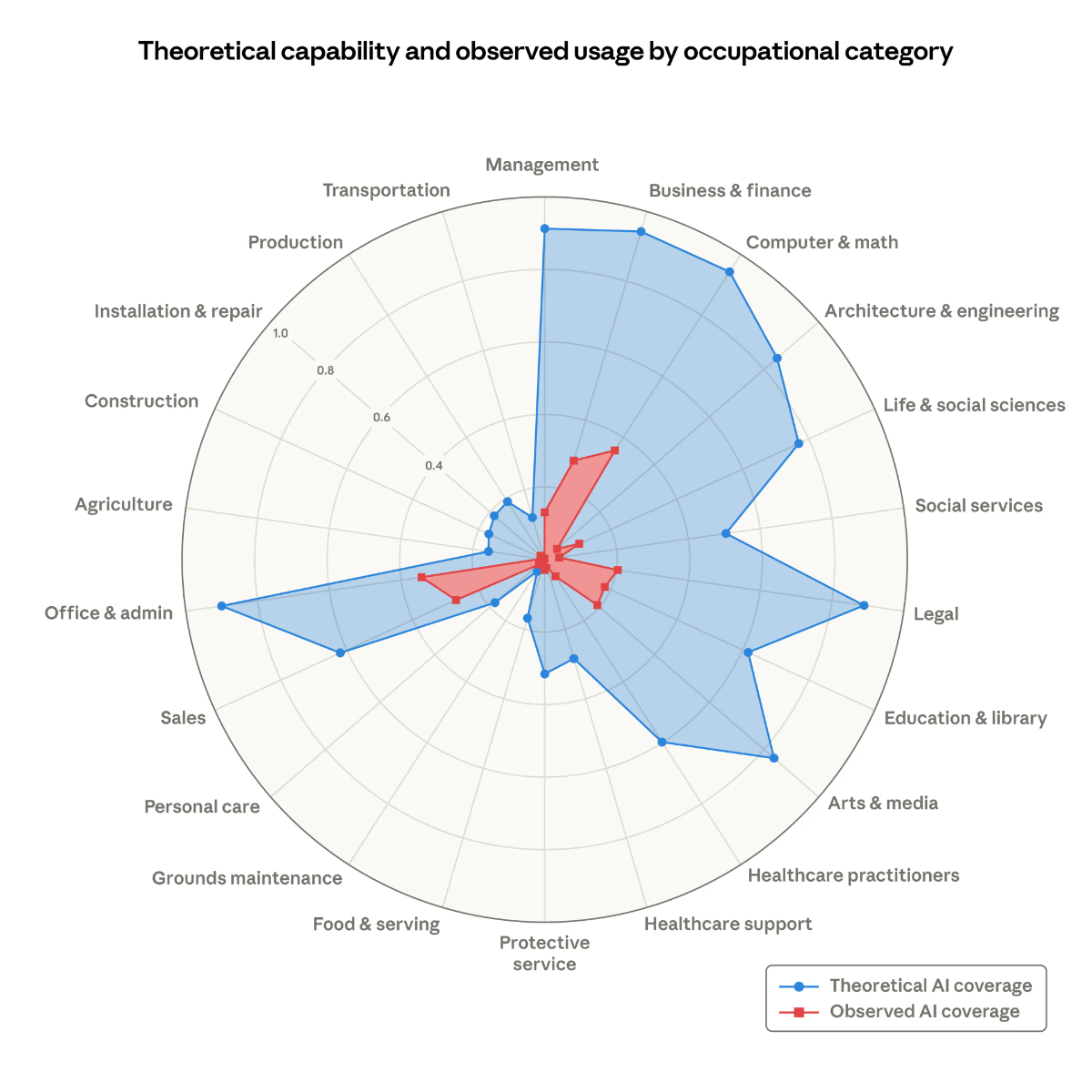
Image credited to Claude.AI. The chart looks highly alarming and considering the recent impacts in the job market, nearly all business professionals should be concerned. Change driven by AI is inevitable, and as we've seen from history, this won't be the last disruption.
- The fallout from the digital revolution took years, and the impact was softened by the difficulty of developing reliable products that took advantage of the new technologies.
- Part of what protected the exposed careers was that to develop software took years and cost millions.
- In contrast, AI enables the output of quality software products in some cases in only days to well-scaled platforms in barely a month.
- Another similar plus was the growth of the computing industry. Millions of new jobs were added as a result. Optimistic economists and labor experts predict the same will be true for AI.
OpenAI made their announcement about the public release of ChatGPT on November 30th, 2022. In less than three and a half years, AI is already making a large impact. Unlike the industrial revolution and its impact, the age of AI is predicted to change the job market by improving efficiencies. But it is not replacing the human—it's amplifying us.
Examples of AI's Impact on Jobs
- Junior software engineers increasingly rely on AI tools like IntelliJ integrated with Claude, which can generate boilerplate code and reduce the time spent on routine coding tasks by 40-50%.
- GitHub's own data shows developers using Copilot report faster completion of standard programming assignments, allowing them to focus on more creative problem-solving and design (GitHub Copilot, 2025).
- In our own experience, AI reduces what could take two weeks and three engineers down to a few days and a single engineer.
- Customer support agents use AI chatbots for initial query triage, enabling them to dedicate more time to complex escalations and personalized service. A 2025 survey by Zendesk found that organizations employing AI chatbots saw a 30% reduction in first-contact resolution times, improving overall customer satisfaction (Zendesk, 2025).
- Data analysts also benefit from AI-assisted tools that automate basic querying and generate first-draft reports. For instance, Microsoft's Power BI integrates AI features that help analysts quickly visualize data trends, freeing them to interpret results and advise stakeholders strategically (Microsoft Power BI, 2025).
This shift emphasizes the growing expectation for employees to complement AI capabilities with human judgment, creativity, and interpersonal skills.
The Real Threat: Stagnation
The primary threat for most isn't sudden unemployment. It is stagnation. Professionals who fail to adapt risk becoming less competitive compared to peers who integrate AI into their workflows. A 2026 survey by Resume Now revealed that while 60% of workers believe AI will eliminate more jobs than it creates, the reality is more about transformation than replacement. As AI adoption accelerates, those who resist learning AI tools may find themselves sidelined in hiring and promotion decisions.
Recent large-scale layoffs in major tech companies illustrate this trend. For example, Oracle announced layoffs to approximately 30,000 employees in early April 2026, citing AI-driven automation and restructuring as key reasons (Reuters, 2026). These cuts reflect how AI is prompting companies to streamline operations by automating repetitive roles, particularly in software development and administrative functions. Oracle notified their employees by email on Monday after Easter and cut their access to the buildings. While these sudden layoffs appear cruel, frequently employees have fair warning that change is coming. Waiting for rumors is risky in today's world. We know change is coming.
Policy and regulation have struggled to keep pace with rapid AI advancements, leaving a gap that places responsibility on individuals to proactively maintain their employability. Waiting for employer-led training or government intervention is increasingly seen as insufficient. As Sundar Pichai, CEO of Alphabet, stated in a 2025 interview, "The future workforce must embrace AI not as a threat, but as a powerful tool that amplifies human potential. Adaptation is not optional; it’s essential" (CNBC, 2025).
Research indicates that while AI can enhance productivity and create new job opportunities, it may also exacerbate income inequality as lower-skilled jobs are more susceptible to automation.
Research indicates that while AI can enhance productivity and create new job opportunities, it may also exacerbate income inequality as lower-skilled jobs are more susceptible to automation.
To understand how these changes are already affecting the workplace, let's look at how AI is being used today.
How AI Is Changing Work Today (Not Just in Theory)
Since ChatGPT’s late 2022 launch through 2025-2026, AI moved from initial tools to embedded everyday software in many workplaces. This isn’t theoretical anymore—it’s happening in the tools you likely already use.
AI in Everyday Workplace Tools
Concrete examples of AI in common workplace tools:
- Microsoft 365 Copilot:
- Drafting in Word
- Data synthesis in Excel
- Meeting summaries
- Processing vast amounts of data for analytics to aid improved decision-making and support business strategies
- Google Workspace AI:
- Summarization in Docs/Sheets
- Email drafting in Gmail
- GitHub Copilot:
- Code generation
- Debugging assistance
- Documentation
- Customer service platforms:
- Automated triage
- Response suggestions
- Ticket routing
AI excels at tasks that are repetitive and time-consuming, such as data entry and scheduling, which enhances employee productivity on more strategic work. It also excels at summarizing information, drafting emails and content, generating code, and automating simple workflows and reports. These are tasks that previously consumed hours of employee time each week, and AI-driven improvements in workflow performance are now a key benefit.
This changes role expectations significantly. Employees now spend fewer hours on routine tasks but face increased expectations around judgment, prioritization, stakeholder communication, and problem framing. The person who can ask the right questions matters more than the person who can produce basic output.
Organizations increasingly screen for AI literacy in job requirements. Analysis of 2026 job postings shows growing emphasis on ability to use generative AI tools safely and effectively. This skill is becoming as basic as computer proficiency was a decade ago. Next, let's examine which jobs are most exposed to AI automation and why.
Which Jobs Are Most Exposed to AI – and Why?
AI exposure refers to the likelihood that tasks within a job can be automated or augmented by AI, especially those that are repetitive, rules-based, or data-driven. AI-augmented roles are positions where AI tools assist or enhance human work, rather than fully replacing it.
High-Exposure Roles in 2026
Exposure depends on tasks, not prestige or salary. Some high-paid and low-paid roles are both vulnerable if they involve rules-based, digital work with repeatable outputs.
- Entry-level programmers (Claude, ChatGPT, and Grok augment 60-80% of basic coding tasks including testing, debugging, and common structure)
- Data analysts (AI automates basic querying and visualization)
- Customer support agents (80% of queries routed to bots in some organizations)
- Paralegals (contract summarization and document review)
- Content writers (draft generation and editing)
- Back-office finance and HR roles (workflow automation)
- Over 90% of data entry clerks, receptionists, and payroll clerks are at high risk for AI automation.
Research mapping 32,000 skills across 923 occupations identified $1.2 trillion in wages exposed to AI augmentation or automation. The common pattern is clear: work relying on structured data, clear rules, and repeatable outputs is easier to automate or heavily augment. AI's influence is most pronounced in white-collar and knowledge-based roles, marking a departure from previous automation waves that primarily affected manual labor.
Reskilling is critical, with an estimated 50% of all employees needing reskilling due to technological changes.
Demographic Impact and New Opportunities
Demographic impact matters here. Younger professionals and women are statistically more represented in these exposed positions, amplifying career risk for these groups. Early-career workers (under age 25) are particularly vulnerable to job displacement in AI-exposed sectors due to a reliance on basic tasks. The first two months of 2026 saw 32,000 tech layoffs, with 55,000 AI-attributed cuts in 2025 alone.
In exposed roles, AI removes low-value tasks first. As a bonus for the young, this levels understanding and creates opportunity for people who adopt early. Historically, these individuals move up the stack into more complex responsibilities. The question becomes whether you can identify what remains uniquely human in your work.
Moreover, AI’s advancement drives the emergence of entirely new roles across industries, regardless of an individual’s former position or salary. As routine tasks become automated, organizations require professionals who can design, manage, and optimize AI systems, as well as those who specialize in interpreting AI outputs and integrating them into decision-making processes. This shift means that employees at all levels have the chance to reskill and transition into innovative roles such as AI ethicists, prompt engineers, or AI workflow managers. Reskilling is critical, with an estimated 50% of all employees needing reskilling by late 2026 due to technological changes. By embracing AI now, and building believable signals, individuals can unlock opportunities to leverage their early expertise. For many, AI is creating new pathways for career growth beyond what was available before. Automation can also save time and resources, allowing organizations to focus on higher-value activities and ensuring recruitment strategies focus on finding the right fit for roles, with measurable objectives like reducing time-to-hire and improving candidate quality.
As we see which jobs are most exposed, it's equally important to understand which roles are least likely to be replaced by AI in the near future.
Jobs AI Is Unlikely to Replace Soon
The safest roles combine human judgment, complex context, and interpersonal trust that current AI cannot fully replicate. These positions require what researchers call uniquely human capabilities. Jobs requiring deep empathy, high emotional intelligence, complex manual skill, or high-stakes judgment are least vulnerable to AI automation.
Resilient job characteristics:
- High human interaction (therapists, teachers, hiring managers)
- Complex physical work with variability (electricians, nurses, manufacturing specialists)
- High-stakes decision-making with accountability (surgeons, senior legal counsel)
- Cross-functional orchestration (product managers, project management leads)
- Relationship-driven outcomes (enterprise sales, strategy roles)
Concrete examples across sectors include product managers who coordinate between teams, nurses who handle variable patient situations, skilled trades like plumbers and electricians, early-childhood educators, and enterprise sales professionals building relationships over time. Healthcare roles involving direct patient care, such as those of physicians and nurses, may be augmented by AI but remain necessary due to the critical need for human performance in these settings.
Resilience isn’t permanent. Roles remain safer when people inside them keep strengthening uniquely human skills and learn to orchestrate AI effectively. Complacency in any position is risky. Now that you know which jobs are most and least exposed, let's discuss how you can assess your own risk and take action.
How to Tell if YOUR Job Is at Risk
You can self-assess your AI exposure by analyzing your daily tasks rather than focusing on your job title. This practical approach gives you actionable intelligence, and using helpful resources or tools—such as online self-assessment checklists or AI risk calculators—can make this process easier.
Self-audit process:
- List every task you perform in a typical week
- Mark which tasks are repetitive, rules-based, digital, and text or data driven
- Estimate the percentage of your time spent on these marked tasks
- Review recent job ads in your industry for AI tool mentions
If more than half your time goes to tasks AI can already partially perform—drafting standard emails, creating basic reports, simple coding, data entry—your role has elevated exposure. This doesn’t mean immediate unemployment, but it does signal vulnerability.
Check 2024-2026 job postings in your field to see how often employers mention AI tools and automation in requirements. The frequency of these mentions has increased dramatically, particularly in tech, finance, and services sectors.
For next steps, a key piece of advice is to proactively upskill and seek out tasks that require human judgment, creativity, or interpersonal skills. Use skill-validation platforms like KnocScore to show demonstrated competencies beyond easily automated tasks. This signals to employers and recruiters that you’re positioned above the automation line, with capabilities that complement rather than compete with AI.
When following up with employers or networking contacts, personalize your communication by considering whether you are on a first name basis. Use a first name only if the interviewer or recruiter has indicated that level of familiarity; otherwise, address them with formal titles. This attention to appropriate tone and personalization can help you stand out, especially when expressing your interest in adapting and learning new skills to reinforce your suitability for evolving roles.
How KnocScore Helps You Compete in an AI-Driven Job Market
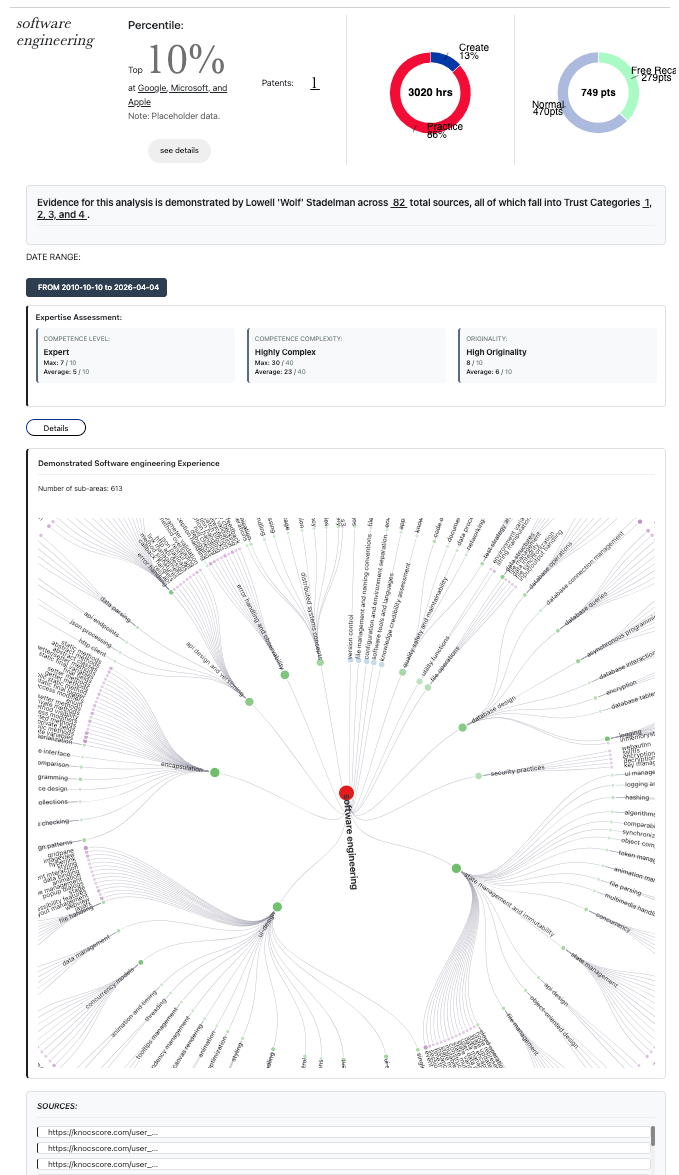
KnocScore provides a way for individuals to prove real, role-specific capabilities in a labor market reshaped by AI. By creating and managing your KnocScore account, you can distinguish your professional profile and demonstrated actual competence. You make it easy for them to fact check your claims from reliable sources. Recruiters and employers are highly aware of the flaws in their hiring systems and bad hires have a high cost. By using the KnocScore, your validating that your claims are true. Honesty and willingness to adopt is highly sought after. "If an individual has 'most' of the skills we need, demonstrate an eagerness to work, and can adopt to changing environments, they are favored."
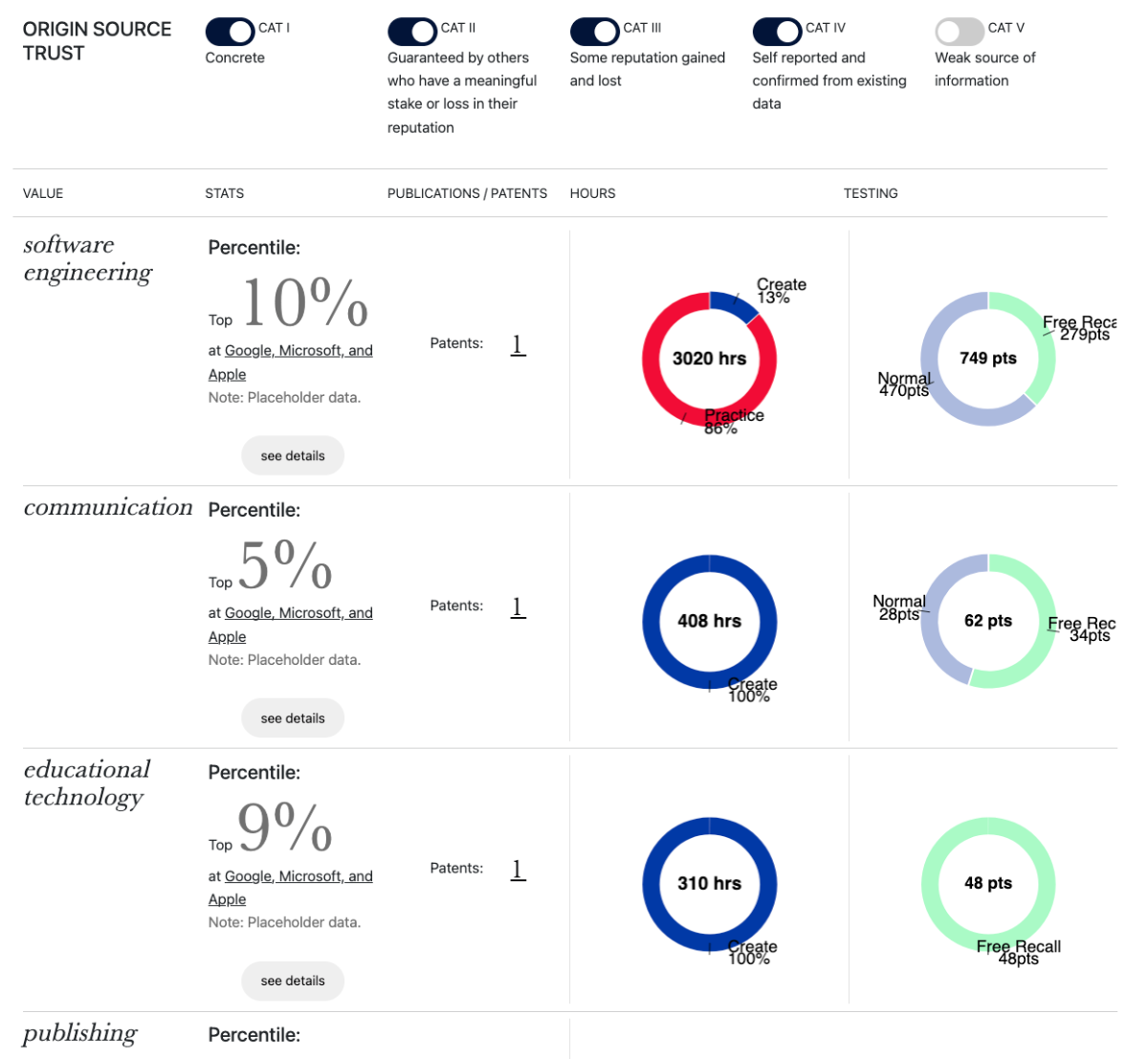
The KnocScore isn't a single score. It is an aggregation and auditable display of historical data related to skills, competencies, knowledge, and expertise. It demonstrates dedication, experience, and depth by fields of knowledge. It takes lessons learned from selection processes used by Military Special Forces and applies the principles towards expertise, skills and knowledge. It draws from criticisms and insights from well known authors such as Malcom Gladwell, and excellent research and studies in business and economics across many education institutions.
Prove capability over assumption:
KnocScore is a truth first system. It signals your capabilities based on demonstrated skills, true outputs, and domain expertise rather than hand waving with an opaque degree or job title. This matters. Education and experience is highly important. Unfortunately, traditional grading and evaluations systems are prone to non-relevant bias and error. Testing systems are easily deceived. And qualifications on paper do not accurately communicate what a person can deliver in any skill, much less in the future AI-augmented world.
Stand out in saturated markets:
In AI-exposed fields like software engineering, data analysis, and customer support, candidates with validated skills differentiate themselves from applicants relying solely on opaque credentials. When hiring managers review hundreds or thousands of similar resumes, demonstrated capability catches attention and helps foster a personal connection with recruiters.
Showcase your AI expertise and adoption:
KnocScore can highlight your capacity to work alongside AI tools: designing effective prompts, reviewing AI output, and validate impactful results. Through the use of its auditing capabilities it allows the observer to determine an applicants ability to apply higher-level reasoning that they need to hire.
This approach is especially valuable for younger professionals looking for a way to break through traditional barriers highlighting actual experience and demonstrated skill. When you can’t rely on decades of employment history, verified capabilities speak louder than assumptions and can help you communicate with recruiters on a trusted basis. With the right tools and mindset, you can take practical steps to future-proof your career against AI disruption.
Practical Steps to Future-Proof Your Career Against AI
The most effective response to AI risk is not panic, but deliberate and early upskilling and purposeful positioning on knowledge credibility platforms like KnocScore. Adapting to AI can be challenging, but historically, proactive action has given early adopters massive advantages while those who wait play catch up, pay higher fees, or never recover. Fortunately, investing in upskilling is something most professionals can afford, especially compared to the long-term costs of falling behind.
A study by McKinsey Global Institute estimates that by 2030, up to 375 million workers globally may need to switch occupational categories due to automation and AI advancements.
Recommended actions now:
- Master AI deeply then focus on a platform. LLM’s are very similar and interaction isn’t difficult. Understanding their nuances and how to take advantage of their strengths is key. Learn to use ChatGPT, Claude, or Copilot for your specific domain tasks by mid-2026. Surface-level familiarity isn’t enough—invest in understanding capabilities and limitations.
- Shift focus up the stack. Move from execution tasks like manual report creation toward problem definition, stakeholder alignment, decision-making, and experimentation. These remain human strengths.
- Build an impact portfolio. Document projects where you designed processes, integrated tools, or led cross-functional initiatives. Show work that demonstrates judgment, not just output.
- Prepare for conversations about value. Be ready to speak to how you create outcomes that AI alone cannot achieve.
- Attend industry events. Participate in job fairs, conferences, and meetups to network, learn about new trends, and showcase your skills to potential employers.
Critically, as you upskill and work, document and validate these skills so employers can see evidence that you operate effectively in AI-enhanced environments. In skills-based hiring, objective proof matters more than claims on a cover letter. KnocScore is evidence based and similar to a FICO score, takes time to build.
A strong talent pipeline helps organizations fill roles quickly and efficiently by identifying future hiring needs and maintaining relationships with potential candidates. As you develop your skills, encourage internal mobility and growth by seeking feedback, pursuing development plans, and being open to new opportunities within your organization.
The World Economic Forum projects 92 million roles displaced through 2030, but 170 million new ones. Positioning yourself for the new roles requires demonstrating capabilities that matter in an AI-augmented world. As you prepare for the future, it's important to know how to position yourself for hiring and promotions in the AI era.
Positioning Yourself for AI-Era Hiring and Promotions
Hiring practices are evolving. Candidates now need to signal both domain expertise and AI fluency to stay ahead in the interview process and demonstrate how they can optimize performance in their roles.
Update your professional presence:
- Reskilling is critical, with an estimated 50% of all employees needing reskilling due to technological changes.
- Add concrete AI examples to your resume and LinkedIn: “reduced report preparation time by 40% using generative AI tools” or “implemented AI-based customer triage workflow to improve performance”
- Show validation of your knowledge and expertise in your resume and Linkedin Profile using your KnocScore
- Quantify results wherever possible—numbers make claims credible and show how you save time or resources
- Mention specific tools you’ve used (ChatGPT, Claude) with context about how you applied them to boost performance
Optimizing your job search for recruitment efforts by considering location preferences or targeting specific regions. If recruiters are using a strategy to improve their ability to hire top talent, use their strategy to improve your odds of hire pay.
Many businesses are experimenting with skills-based hiring in 2025-2026. This trend favors candidates who can show objective proof of capability and demonstrate they are the right fit for the role, rather than relying solely on credentials or company names. The application process increasingly involves demonstrating what you can do, not just listing where you’ve been. This is where KnocScore helps.
KnocScore fits into this trend by helping candidates present verified, role-specific skills that align with AI-augmented job descriptions, ensuring you are seen as the right fit. When recruiters can see evidence of your capabilities, you move from the pile of applicants to the shortlist of top talent. Stories of successful candidates who leveraged these strategies show how you can save time and resources while improving your chances.
Treat AI not as competition on your resume, but as evidence of adaptability and leverage. Employers increasingly value people who can orchestrate both human and machine contributions. The person who can manage AI tools while maintaining human judgment becomes more valuable, not less.
With these strategies in mind, let's address some of the most common questions professionals have about AI and job security.
FAQ: Common Questions About AI and Job Security
Will AI fully replace your job in the next 5 years?
Full replacement is unlikely for most roles by 2031, but the mix of tasks inside your job will keep changing. The World Economic Forum projects significant displacement alongside even greater job creation, suggesting transformation rather than elimination.
The biggest risk isn’t sudden layoff from robots. It’s gradual erosion of your value if you avoid learning AI tools while your peers embrace them. Companies may not fire everyone in a department, but they might not backfill positions or may restructure teams around people who can work with AI.
Review your tasks annually and continuously move toward responsibilities requiring human judgment, coordination, and creativity. This ongoing adaptation is your best insurance against unemployment.
Are entry-level roles in more danger from AI than senior roles?
Entry-level roles often include work that is easiest to automate—basic research, drafting, data cleanup, and routine coding. This creates heightened exposure for those early in their career.
This makes it even more important for career professionals to quickly demonstrate higher-level capabilities through projects, portfolios, and tools like KnocScore. Strong junior candidates who can manage AI and show impact may actually advance faster than in the pre-AI era, as they differentiate themselves from peers who only perform basic tasks.
How can I show employers that I can work effectively with AI?
Document specific examples where you used AI to improve speed, quality, or outcomes in real work. Be concrete: “Used Claude to create first drafts of client proposals, reducing turnaround from 3 days to 4 hours while maintaining quality.”
What if your company isn’t using AI yet—should I still care?
AI is the powerful undercurrent of a calm river. It appears calm at the surface until it's too late. If your current employer has been slow to adopt AI, the broader industry is moving quickly. Consider what happened to legacy companies like Kodak. Where digital cameras made the film industry obsolete. Kodak was a well-known company. Popular bands wrote songs that included their name and the term Kodak was adopted to take on far more than just the company. They were a big brand, but if you're younger than 25, you've probably never heard of them.
Considering what happens when companies don't shift. In a 2026 survey, only 22% of executives had fear rapid AI replacement. 41% viewed it as transforming hiring and workforce structure. Bloomberg experts have been talking about the problem for a while. With exception to industries that are primarily human labor. That number should be much higher. If your company isn't moving towards adoption—not just thinking about it, but moving towards it—you should feel a strong sense of unease. Industries are pivoting, whether individual companies keep pace or not will likely determine who is dropped and who is named in stock markets. And that's another consideration. If your company isn't in the process of adopting AI, will they lose their investors?
Here is what to do now:
- Take online courses and earn certificates from institutions that are leaders in AI like Stanford, Berkeley or MIT. If you have a technical background, Sebastian Thrun, Professor at Stanford, Led the winning team in autonomous vehicle development for DARPA, founder of Waymo and a major ed-tech company, has an excellent series that provides the theory on AI. From which everything else can be easily understood.
- Use tools and side projects to gain comfort with AI capabilities. Explore what’s possible in your field. This preparation positions you well if your employer catches up or you decide to connect with opportunities elsewhere.
Early adopters that bridge current understanding in the problems of their industry with new technologies are historically chosen to lead transformation projects and gain visibility. Being the person who understands AI when leadership finally prioritizes it is a significant success factor. It also positions you to replace the leadership or start your own company.
Do I need to become a programmer or AI expert to stay relevant?
Most professionals do not need to become machine learning engineers, but it helps. A good start is gaining AI literacy. Deep technical specialization is often how individuals become leaders in pivoting industries, but for most it can come later if needed.
AI literacy means understanding what AI can and cannot do, how to design effective prompts, how to identify and correct AI errors, and where human judgment remains critical. You don’t need to build the AI tools—you need to use them effectively.
Pairing domain expertise with AI literacy creates durable career positioning. Consider the value of understanding multiple roles. A financial analyst who understands regulations AND can leverage AI for research is more valuable than either a pure
AI technician or a traditional analyst working without tools. Validate both capabilities through evidence and platforms like KnocScore to determine your competitiveness for the decade ahead.
Your employability in 2026 forward depends less on your current position and more on how quickly you adapt to AI-augmented workflows. The professionals who thrive will be those who prove their capabilities through demonstrated results, not assumptions based on job titles.
Start this week: audit your tasks, identify your exposure, and begin building evidence of skills that matter in an AI-enhanced world. Platforms like KnocScore can help you translate evolving capabilities into credibility that hiring managers can trust. Timing is important. The resources are available—the question is whether you’ll invest the effort to use them.
Publish in the KnocScore Journal.
Long-form writing in your domain contributes to your KnocScore and gives your work a home readers can trust.
We've just released our Article Create and Publication platform. This is the first article written with it. User's can create long form content and receive recognition 'Knoc' for their contributions. We do not limit reach nor do we limit exposure. Others who comment on your articles, provided thier comments add value, gain exposure and reach. Individuals who have expertise in the same domain will be ranked higher due to their expertise.